Showing posts with label books. Show all posts

Friday, August 31, 2012

A Visit to the Curious George Store with Jackie Gonzalez

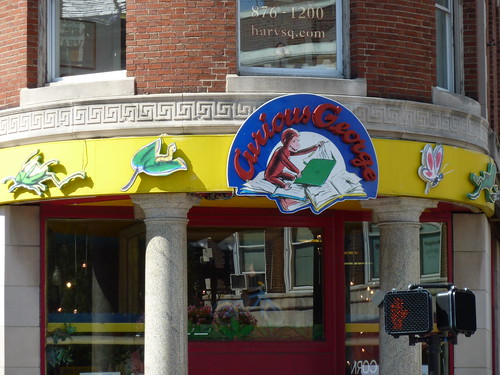
I was turning a Curious George book carousel, seeking the perfect souvenir, when someone started pushing it in the other direction. She had arrived! Jackie Gonzalez, fellow Tufts grad, children’s media scholar and enthusiastic, and kids tech expert, joined me for a spin around the new Curious George Store in Harvard Square. The store had closed during my final semester at Tufts, and I think the whole Boston kids' media and education community let out a joint sigh of relief when it reopened this spring.

The entrance maintains its historical look, but the heightened centrality of Curious George is evident. In its last incarnation, the store sold a mix of many different books and characters. Now, George takes the forefront, with a smattering of other seemingly exclusive books and merch for kid lit lovers big and small.


I really enjoyed the beautiful murals of George and his friends, and I couldn’t help but crawl into a small space created just for kids. The saleswoman at the store shared that this is one of her favorite features, as it allows kids to feel ownership over the store, using the space for play and quiet reading. It’s quite sweet that the store resides in Boston, just a few miles away from WGBH’s studios, home of the Curious George series produced for PBS.


Jackie and I shared a few of our favorite finds with one another. Jackie loved the imaginative play magical wand that plays a musical note when tapped against a surface (she’s SUCH a science nerd). I really loved the mini animals you could pick and choose from. I appreciated that there was something in this store for everyone, no matter what your budget. We both loved the Nancy Drew Cookbook. It must be a future gift for someone!

We ended our reunion with brunch at a nearby cafĂ©. Jackie, perhaps without knowing, ordered a thematic  dish: a peanut butter and banana sandwich. George would be impressed…and then probably try to eat it.

Monday, October 10, 2011

iRead: My Place

Did you ever draw floor plans or maps as a kid? I loved making my home and neighborhood feel like a place where adventures could happen! My friends and I would use our maps to find pretend treasure or to create neighborhood walks. The book My Place, by Nadia Wheatley and Donna Rawlins, shares the stories of twenty-one kids over a span of 200 years. Each story shares information about the child, her family, and the neighborhood they live in as well as a map of the neighborhood. (SPOILER ALERT!) By about the third page, you realize each story takes place in the same home and each map is a variation of the neighborhood, tracking the changes from decade to decade.

The story, published in 1988, represents Australian history. My Place is a picture book but filled with a lot of text and information. I think children over 7 would enjoy reading this alone, but I could see myself reading it to kids as young as 4. I learned about it from a recent Kidscreen article. The book was turned into an Australian television program last year; each episode sharing a different child’s story, a different moment in time. They’ve renewed the show for another season, and I'm so curious to see it. You can read more about it here.

Though this is an Australian story, I think there’s something we can all relate to. Regardless of the kind of home we live in, everyone’s neighborhood has seen change and development over the past 200 years. Wouldn’t it be interesting to track the changes and the history of your own home and neighborhood?

I would have loved to use this in my Kindergarten classroom. I would have introduced the story to my students, probably reading it over a course of two days. As a class, we could create a history of our school and school neighborhood. Maybe we'd bring in the school director or parents who attended the school to interview and help us create our map and story. At home, each family could create their own map and brief history to be shared somewhere in the classroom.

My Place is out of print, but I highly recommend you purchasing a used copy here! Do you think this show would succeed in the US?

Tuesday, September 27, 2011

Amazing Artist Annie

How lucky am I to be working with some amazingly talented people? My desk neighbor, Miss Annie Sklaver, is a Brooklyn-based visual artist. Annie learned how to cut paper in preschool and hasn't turned back since! Her beautiful work, often 3-dimensional, is brought to life with a scissor and colored or patterned paper, and she specializes in illustrations and custom portraits. I'm particularly partial to the circus pieces.

Right now, Annie is working on writing and illustrating a book for children. I think her work is so well-suited to children’s literature and could bring a story to life in a very new, interesting way! I can’t wait to see what she comes up with and hope that we can all get a sneak peek here. I'm holding out for a pop-up book!

Her work is currently featured at Brooklyn Collective, which Joe and I checked out on Friday. We left with three of Annie’s note cards and tons of inspiration.

Wednesday, August 10, 2011

King Bidgood's Bathtub Lesson

Two weeks ago, I said goodbye to my students and Massachusetts friends. I'm glad to be home, but I think I miss my students most. I enjoyed working at the school and learning from the children. I absolutely learned something new from them every day!

Our summer preschool group did a pretty great project that I wanted to share. Have you heard of King Bidgood's in the Bathtub? It's the story of a king who is in his fancy bathtub and just won't get out. He eats, plays, and meets in the tub. Our group loved this story!

After we read the story, we decided to use clay to create a giant bathtub. The children then created items from the story to put in the tub. Once the clay was fired, painted, and fired, we recreated the story and put the items into the tub until it was filled. The children were also able to take their clay creations home with them at the end of the week.

Clay is an amazing medium for children to work with. This year I saw preschoolers work with clay for over 30 minutes just created and destroying different shapes. It takes a great deal of focus and energy and can be a lot of fun. Try it out!

If I were to do this again, I might use a sensory table as the bathtub. The clay bathtub takes some time to create and a lot of space in the kiln to fire.

You can get your copy of the book here!

Thursday, June 30, 2011

Pottermore

When Harry Potter first hit US bookshelves, I was in middle school. I felt I was far too old to concern myself with fantasy novels for kids. The summer before attending Tufts, though, I read the entire series. How could I study children's media without having read Harry Potter? It was the best decision I ever made!

The most well-loved creators are storytellers: playwrights, composers, lyricists, puppeteers, animators, and J.K. Rowling is, in my opinion, the most creative living human of our time. The universe she's created empowers children to defeat evil and read 500+ page novels. Books, movies, costumes, a new collegiate sport, a theme park, and yet we still want more? It's a licenser's dream!

I'd be a very silly and ignorant children's media lover and blogger if I did not mention the Pottermore launch. Have you heard of it? The Twitter feed seemed to give away the secret far too soon. J.K explains...


So, really, what is Pottermore? Most importantly (and wisely), it's the only retailer for Harry Potter eBooks. Secondly, it's a virtual experience where online participants can experience the world of the stories. Will I partake? Probably not, but I'm curious to see how well it does and how long it survives. Part of the launch includes bidding to participate in the test trials. Is it just me or does it not seem very exciting?

I'll definitely be tracking Pottermore's progress and am looking forward to a future blog or two about it. Until then, follow the owl?

Tuesday, June 28, 2011

iRead "Kid Made Modern"

Do you remember Todd Oldham? His fashion designs received acclaim in the '90s, leading him to host the MTV show House of Style (when MTV was still airing music videos). I'm not quite sure when I fell in love with him. Perhaps when he began to focus on interior design, particularly his delightful mid-century dorm products for Target! I still have my Todd Oldham for Target (year 2) two-tone mini-coffee table.

During my high school job at American Eagle in a New Jersey mall, I would ring Mr. Oldham up for his polo shirt purchases. I'm pretty sure he had a country home in the area, and I'm pretty sure he knew how much I loved him. I can't help but think about buying some of Oldham's new Charley Harper/Fishs Eddy pieces for my future apartment!

When I saw his latest book Kid Made Modern, I had an inkling it would be filled with fun projects to do with my cousins, my students, and by myself. This book definitely did not disappoint! The cover boasts "52 kid friendly projects inspired by mid-century modern design" and should be a required text for any school art teacher. In addition to the "52 projects," Oldham provides a thorough description of modern design, features several prominent modern designers with projects inspired by their work, and includes two pages of additional resources (more designers to look into, museums to visit, craft stores, and websites).

Before you read about any individual projects, there are four pages of craft supply kit items. I could easily spend two days going through these items with my cousins (ages 7 and 12), purchasing which ones we thought were most important, and developing our very own kits. This is a fantastic idea for rainy or "too hot" summer days. My favorite projects include (but are certainly not limited to): painted, wooden spoon friends (p. 26), plastic crate stool (p. 60), light cubes (p. 110), potato scarf printing (p. 130), paint chip and paper clip screen (p. 144), and a pegboard desk (170). I'm hoping to work on a few of these projects soon and will post on my progress.

The inspiration saver (p. 182) really caught my eye. As a creative child, I was constantly ripping out magazine pictures of clothes, furniture, or images that interested me. It wasn't until I was 18 that I started to collect and organize these images in an accessible way. The inspiration saver is simply a binder and page protectors that allow children (or adults) to collect and reflect on images that spark their imagination and artistry.

There are a few projects in the book that require sewing machines, and some using a sharp utility knife. The sewing projects in particular, though, seem much more difficult and may require more adult supervision and help. I recommend looking through the book before handing it over to a child. Highlight three or four projects that work well with your schedule and level of ability. Move on from there!

I recommend this book for children and modern design lovers ages 6 and up. There is something for everyone! You can find it on Amazon here.

Thursday, June 23, 2011

iRead "Make Art Mistakes: A Creativity Sketchbook"


Before beginning grad school, I worked to manage and grow the Family Workshops program at The New Victory Theater. I was consistently inspired by the MoMA (Museum of Modern Art)'s family programs. They offer workshops, talks, and gallery guides for families, which are usually free or heaviliy subsidized.

I particularly enjoyed reading through their gallery guides. The team of arts educators who developed these, used very direct and accessible language. You can only imagine how thrilled I was to find their new art book for kids on a recent museum visit! The MoMA has just published Make Art Mistakes: A Creativity Sketchbook.

The book is filled with motivational quotes from well-known visual artists and provides a scaffolded guide of experimental art activities, including line-drawing, portraiture, and pattern-making. Included on almost every page of the book are those well-written directives that made me love the MoMA family guides. However, there are a few pages distributed throughout the book that provide blank space for a child's (or adult's) own doodles.

I completely fell in love with several sections of the book. So many pages provide graphing squares or dotes to help create shapes. Two pages at the beginning prompt young artists to draw lines that exhibit different emotions. This kind of activity seems fun, simple, and could support positive emotional development in very young children who are acquiring the vocabulary to identify the way they feel. I also loved the "create a color wheel" section, where artists fill in the shades between the primary colors. Lastly, the book provides three spaces "to record the color of the sky at three different times of the day." It might be nice to do some of these activities on large pieces of paper for homemade artwork to hang on the wall.

My only criticism is that the book would value from more descriptions. If I was a young artist, I might wonder, "What is a portrait?" "What is texture?" "How do I create rubbings?" Putting the descriptions right on the page of the directive might be nice. A glossary could easily be overlooked.

I could see this being a great activity book for a rainy summer day! Though I think kids as young as 3 would enjoy working with this book, I recommend it for ages 6 to 12. It requires a lot of reading and would provide a great deal of independent work for this age cohort.

Learn more about the MoMA family programs here. Buy the book from Amazon and check out MoMA's other books for kids here.

"Don't worry about mistakes. Making things out of mistakes, that's creativity." -Peter Max

Wednesday, June 22, 2011

Curious George Learns About Business

The Curious George Bookshop is one of those special places that defines a neighborhood. It's unique corner storefront pull you in as soon as you exit the T station. Unfortunately, it's hard to define a neighborhood when that neighborhood is Harvard Square. Much to my dismay, I recently learned that the local shop will be closing this month. CBS Boston provided some great coverage that can be found here.

Curious George Store
In addition to the most full and varied collection of Curious George goodies I've ever seen, the store provided an amazing assortment of picture books upstairs and young adult titles downstairs. My favorite memory of the shop was when I had a full conversation with the salesperson about Moomins after spotting a rare collection of Moomin and Pippi Longstocking tea towels downstairs. Sincerely, this store was a treasure trove and will be missed!

Monday, March 1, 2010

An Awfully Competitive Community

I just finished reading the last three chapters that I assigned myself from The Children's Television Community. These included descriptions of the different kinds of production models. It briefly discussed the CTW or Sesame Workshop model of production, content, and research being of equal value in the development of a program. This was a unique idea that had a huge impact on both PBS and cable programs.
There was a chapter written about the PBS model and one about the cable model written by PBS and Cartoon Network staff members respectively. Below are some of the highlights from each chapter and distinctions I discovered between the two models.

PBS
Commercial free
Education-based quality entertainment
Programming outlet- NOT PRODUCER. They do not own the properties.
Has slightly less control over the shows it distributes and airs since they don't own them
Cable
Usually, but not always, an advertiser-supported model
Branding is important to distinguish each network
Owns and has control over some of the properties
Produces some programs
Sells their educational programing to broadcasting networks (CBS, ABC, NBC)

There was some information that I found particularly shocking: "The amount of money that public television receives per taxpayer is not much more than $1 per year!" That's it?! PBS seems like such a comforting space for children particularly because it is commercial-free. Disney promotes itself as commercial-free, but it is constantly selling the Disney name and airing licensing-driven programs which can then sustain the cost of the network.
These articles really made me think. I thought about how competitive the "community" or industry is right now. If it was this competitive in the '70s, would we have had as many episodes of Mister Rogers' Neighborhood to watch? Competition doesn't completely scare me, but it usually means there are politics associated to it in some regard. Politics scare me. I thought long and hard about what I would do if I was pitching a show. Would I find the network that best matched the goals of my program? Would I choose the network that best matched my personal values and goals? Would I choose the network that offered me the best deal? Would I choose the network that simply offered me ANY deal?! What would you do?

Sunday, February 28, 2010

Making Make Believe & Technology

This week I've thought a lot about make believe. I read a very interesting chapter from the book The House of Make-Believe written by the Singers (who provided research for the Barney television show). It provided me with a lot of great information that will certainly be part of my literature review on interactive television including the importance of auditory clues for young television viewers. This will also come in handy as I prepare my production project.
As I read about make believe and how people are replicating the experience of make believe for children on television, I compared some of their findings with my experiences teaching kindergarten. In some regards, I feel as if I had my most successful week teaching this past week. I introduced the yoga curriculum on Wednesday. As I lead the children through a series of breathing and slow movement exercises, I tell them a story. The story is intended to focus them and help them visualize how some of the movements should look. For example, we rode a camel and straightened our back and rounded our back. This week, I also brainstormed a new dramatic play scenario with some of the children. We decided to play in a submarine and made our own submarine out of large wooden blocks. We had a secret latch, residential quarters, captain chairs for the people navigating, and water-proof walkie talkies so we can communicate while exploring the sea around us. I honestly had such a fun and fast choice time that day! I forgot how enjoyable it was to build a "fort" of sorts and make believe that you really are these characters. I felt so happy and proud that I could help facilitate that experience.
I thought back to when I began teaching this fall and how excited I was to incorporate technology into the classroom. However now, I wonder if it really has a place in the classroom. All of these children spend time at home on websites such as PBS Kids. They are learning how to navigate the Internet before they learn how to read. As an educator, I wonder if technology in the classroom hinders their ability and their time to make believe. Perhaps the classroom is a place for this generation to escape technology. Perhaps it is the place where we can preserve a child's play in its rarest forms. These are things I am continuing to think about.

Tuesday, February 16, 2010

The Obesity Question

The question is: Is television responsible for childhood obesity? It would be silly to argue that the answer is undoubtedly "yes." Of course television can't be solely responsible for the obesity epidemic. There must be various factors that play into a child's diet. I spent a great deal of time researching the problem last semester. I found a social policy report that was particularly helpful throughout my investigation on the Society for Research in Child Development's website. The report is titled "The Epidemic of Childhood Obesity" and can be found at here. It cites environmental factors as a heavy influence including styles of family eating an activity, quality of school lunch and physical education, the design of the physical community environment, and the influences of media on foods and behaviors. AHA! With further research I learned that television not only consumed hours that could be spent on physical activity and play, it also bombarded the viewer with advertisements for high energy, sugar and fatty foods. Children, on average, view over 40,000 television commercials during their chidlhood (CF: Kunkel & Gantz, 1992). A study done by Grund, Krause, Siewers, Rieckert, and Muller in 2001 concluded that children who do not participate in regular physical activity and watch a lot of television are more likely to be obese. Aside from the creation of the Wii Fit video game program, there is arguably no technology or media that has been developed with the main intention of getting the viewer participant physically active.
Other cultures have decided to regulate food advertisements during children's program, but we rely on those funds in the U.S. to pay for our programming. To that end, if we cannot reduce the amount of advertisements for foods, we need to increase our physically active programming and find ways to get our young people active during their television viewing and media use.
In pursuit of further information about the television industry's connection to childhood obesity, I read a chapter from the book The Children's Television Community. This book has given me a much better understanding about the different responsibilities of those in the community and their thoughts about pressing issues in the business. I was excited to start the article "Super-Sized Kids: Obesity, Children, Moral Panic, and the Media" by Rebecca Herr Stephenson and Sarah Banet- Weiser. Unfortunately, the article focused more closely on alternative environmental factors rather than taking accountability for television's impact on the epidemic and posing possible solutions and states that "for companies producing media products for children, the extension of the network brand to the supermarket is an important form of promotion for shows and movies." I support their point of view that children should be taught to navigate media, however, that would require resources for education and parental assistance that are scarce and difficult have been traditionally difficult to acquire in our culture.
Michelle Obama recently launched the Let's Move program to promote 60 minutes of child physical activity a day and support a healthier diet. I leave you with a clip of Mrs. Obama on Sesame Street. I look forward to tracking her progress and strategies!

Tuesday, February 9, 2010

Wartella et al.

It has been almost two full years since I committed myself to returning to school with the intention of learning more about child development and entering the field of children's television. As I began my quest for knowledge, I spent a significant amount of time learning what information was already out there and easy for me to access. I joined the Cynopsis: Kids! listserve which allowed me to become better acquainted with many of the production companies, licensing agreements, and ratings for children's media. I often logged onto the Kidscreen website which provided me with a great deal of information about the key creative players in the industry and currently hosts a wonderful blog written by the president of Little Airplane Productions, Josh Selig. I also spent a significant amount of time on Amazon searching for books about different children's television programs and research. One name that continuously came up in my search was Dr. Ellen Wartella. Dr. Wartella is currently a professor at UC Riverside and a leading researcher in children's media. One book seemed particularly interesting to me as an aspiring scholar. I purchased Children and Television: Fifty Years of Research which was edited by Dr. Wartella with Norma Peccora and John P. Murray.

I have selected several articles from this book for my independent study. They include: "The Changing Nature of Children's Television: Fifty Years of Research," "From Attention to Comprehension: How Children Watch and Learn From Television," and "Is Television Healthy? The Medical Perspective." "The Changing Nature of Children's Television" provides a comprehensive history of television created specifically for children and its corresponding research. This provided me with a great understanding of the roots of the industry and how that past has influenced modern programming. I previously did not understand the full impact of the 1980's on television programming. It was marked with the introduction of cable television into everyday life, Nickelodeon as the station for children, and programming as "a showcase for licensed products" (p 26).

The article that provided me with the greatest amount of information for this independent study on content development was the piece on how children watch and learn from television. I previously did not know that television viewing decreased when children went to school, although it seems quite logical. I was also very intrigued about "active" viewing and the idea that children make "moment-to-moment decisions about when to attend, when to look away, and when to monitor sound for an interesting moment" (p 48). It also emphasized the importance of formal features in a child's viewing experience. As I develop my program, I'd like to refer to this text as a guideline for creating formal features that will not only be interesting to a child but that will also inform the rest of the program.

Although the book was published only three years ago, I did find that there was little comparison of television viewing versus technology use. I believe this is due to the fact that technology, particularly in regards to child-specific media, has experienced a huge boom in the past three years. With the inception of the iPhone application, Video on Demand, and Hulu, television viewing "looks" different. I am interested in finding out more about this comparison and doubtful that research can keep pace with the evolution of the medium.