Showing posts with label guest blogger. Show all posts

Monday, November 5, 2012

Guest Blogger: Ashley Moulton


Ashley Moulton is a preschool television production coordinator and member of Children's Media Association

The Presidential Election for Kids

I have lots of personal memories of presidential elections throughout my childhood. I remember voting for Bill Clinton as a kindergartner in my school’s election because he played saxophone and I thought that was cool. In middle school, learning about the Bush v. Gore case in my Social Studies class illustrated the mysteries of the Electoral College. In high school, I was a political pundit on my high school television station’s live coverage of our Mock Democratic Convention.

I’m sure that lots of kids will remember this election, although perhaps equally as many kids echo the sentiment of four-year-old viral sensation Abigael Evans, who tearfully wailed that she was “tired of Bronco Bamma and Mitt Romney."  If you’re interested in helping kids engage with the 2012 Presidential Election (hopefully sans tears), here are great ways to help them learn more!

7 tools to help kids engage with the election:

When I was a kid, I always wanted to grow up to be the President. This excellent game, by former Supreme Court Justice Sandra Day O’Connor’s iCivics organization, gives kids the chance to find out just how hard it is to be President. Through your own Presidential avatar, you can make speeches, sign bills, and declare war.  I admit: this kid at heart really enjoyed playing!
via
Print out colorable line drawings of both Barack and Mitt, or better yet, indulge your own presidential ambitions by drawing your own face on a campaign poster.

3. Watch kid focused news specials about the candidates and the issues:
Linda Ellerbee’s “Nick News: Kids Pick the President” specials show the candidates from a kid’s perspective. Hear the candidates’ views on issues important to kids such as the economy, illegal immigration, and what constitutes Barack Obama’s most embarrassing moment. Interestingly, the results of the online voting that corresponded with Nickelodeon’s “Kids Pick the President” initiative indicated that if it were up to kids, Obama would be re-elected. The kids have predicted the winner for 5 out of the last 6 presidential elections, and only time will tell if they improve upon their record this year.
via
Click on states to see the different combinations of states it will take to win the Electoral College. Or, predict the states each candidate will win and share your map to show off your expert guesses!
via

Brain Pop has great animated videos that answer questions like “What makes you a Democrat or a Republican?,” “How do people get to be president of the United States?,” and “What happens during voting, how does it work?.”

Choose adorable cartoon versions of the Presidential and Vice Presidential candidates, icons for important issues like healthcare and education, and backgrounds to make it look nice… and voila! You’ve made your own digital bumper sticker. You can save your sticker to the PBS Kids website, and vote on stickers other kids have made.

7. Take a kid to the polls
One of the best ways to interest a kid in the election is to take him or her to the polling place with you. I have fond memories of “helping” my mom vote by pressing buttons in the voting booth. By the time I was old enough to vote myself, I was very disappointed that voting booths no longer had levers to pull (at least in my state). But one thing’s for sure: going to vote with my mom instilled the idea in me that voting is important.

I hope that some of these tools help your little one become more interested in the Presidential Election!

Keep the conversation going @AshboNYC.


Tuesday, October 23, 2012

Guest Blogger: Sarah Wallendjack

In honor of Halloween, Sarah Wallendjack, friend, producer, and President of Children's Media Association, shares all the Mahna Mahna behind her costume tradition.

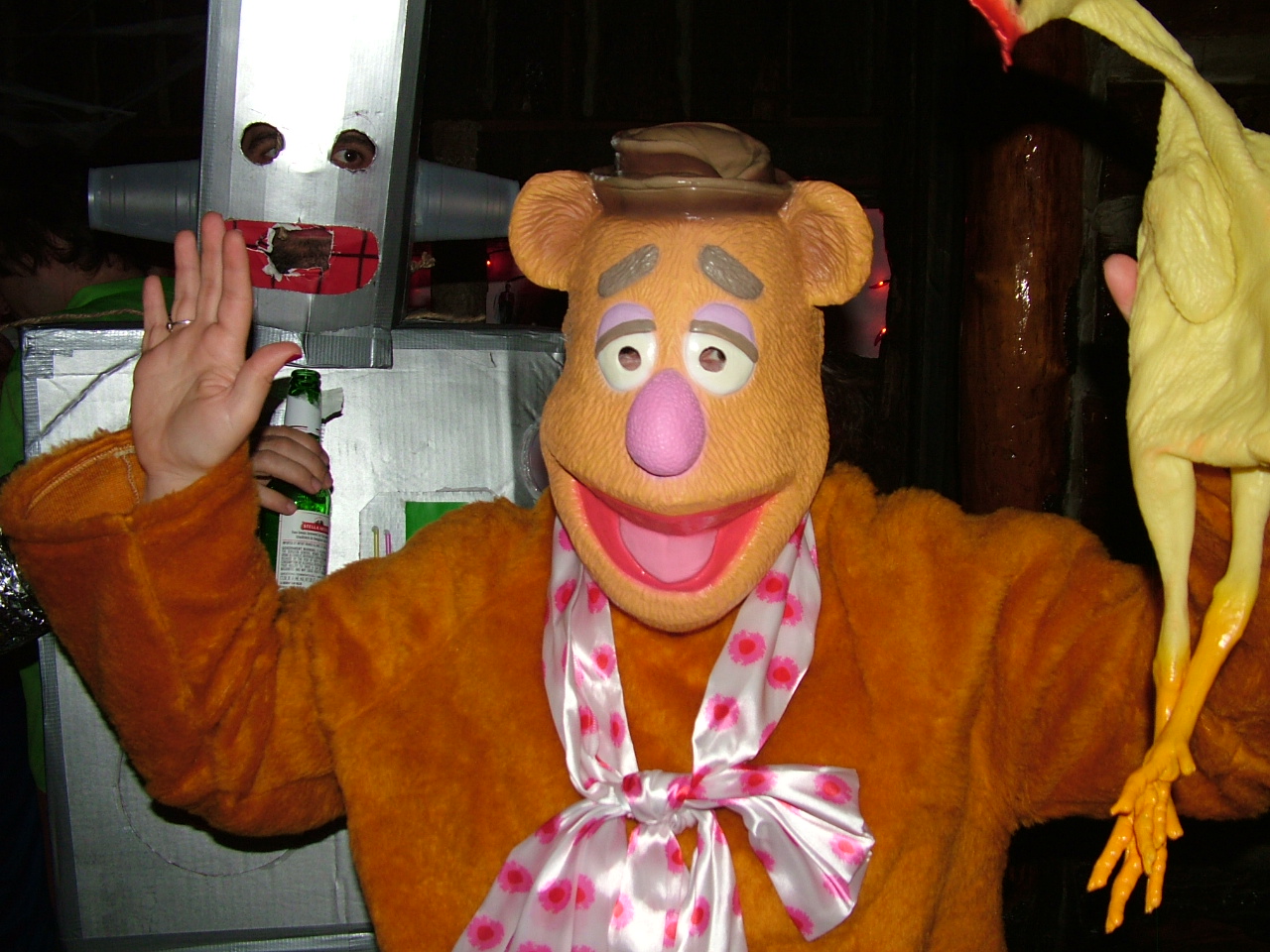
During this time of year, I am usually surrounded by fleece, furry fabric and foam. You see, this year will mark the 10th year in a row I have been dressing up as a Muppet for Halloween. What can I say, it's fun. I have been a Muppet fan as long as I can remember and the magical world that Jim Henson created has left an impression. Jim's philosophy on life has been wisdom I turn to often, and I now work in kid's television.

My Halloween tradition started the year I helped coordinate a Halloween costume party at the animation studio where I was working. I found an Animal costume in the child's section at Ricky's. The head piece was amazing and I knew with some creative scissor and sewing work, I could adapt the child's costume to fit me. The following year, I found a Swedish Chef costume, in an adult size, and all the sudden I had started a trend.   

I found some great 'pimp' accessories and it was easy to transform as Dr. Teeth from the Electric Mayhem. In following years, I was able to find a Miss Piggy wig and a packaged Fozzie Bear costume. Both were big hits. I crafted a yellow yarn wig to help me transform as Janice, mmm, OK, and I donned a green dress, a statue of liberty head piece and a headband with ping-pong balls to attend a friend's wedding as Kermit the Frog. But after that I had to get a little more creative. I knew I wanted to be Gonzo, but couldn't find a costume that felt quite right, so I got crafty and turned an old baseball hat into Gonzo's head with lots of feathers and felt to recreate his signature nose.  


Last year's desire to be Sam the Eagle required some more out of the box thinking. I crafted the head out of foam and an old blue blanket. I visited my friends at the Puppet Kitchen for some professional support and to help make sure that Sam's eyebrows looked furrowed and American. Another hit at another party.


I count some professional puppeteers as friends who help me perfect the Muppet looks. I study lots of photos to make sure I can deliver on the comedic details that make the Muppets so unique. 

It is a fun tradition and my goal is to one day have enough Muppet costumes to gather my friends and march in the Greenwich Village parade as the Muppet Show. I still have quite a number of Muppets to cross of my list.  At a minimum, I get a pretty great Facebook profile photo :) If you would like to see who I am going to be this year, follow me on Twitter @swallendjack to get the first glimpse.


All photos by S. Wallendjack.

Tuesday, March 27, 2012

Guest Post: Aubry Alvarez


(Me and the little sis at Lincoln Park Zoo!)
Hello there! My name is Aubry, and I am a PhD candidate at Northwestern University. I also lecture at Northwestern, and am currently teaching an interesting course entitled “Typical and Atypical Development in Infants and Toddlers,” where we discuss the latest findings on the biological and experiential factors that influence the lives of young children. Broadly speaking, I’m interested in the ways children experience the world. My research draws upon methodologies in psychology, linguistics, and neuroscience. I am also deeply passionate about the creation of quality children’s media. I guess one can say that I’m totally a kid at heart.     

If you’d like to reach out, I’d love to hear from you. You can contact me at aubry [dot] alvarez [at] gmail [dot] com, and on Twitter @aubryalvarez  


Seriously fun: On children, and what they teach us

Consider that the human childhood lasts longer than the childhood of any other animal. We spend about seven to ten years of our life adapting to our environments before we enter puberty. On an evolutionary timescale, the necessity is clear: our large, complex brains require time to develop. Indeed, some of the world’s most influential psychologists have posed compelling arguments for this protracted period of development. Yet, all too often, adults discuss children’s lives with an eagerness for them to mature, rather than focusing on the ‘work’ that children are responsible for during this time. And, as psychologist Dr. Alison Gopnik points out, philosophers have long neglected the role that children may play in our understanding of who we are as a species.

A cute and funny comic, but does it represent the truth? (Photo courtesy of WebDonuts.com)

I’ve always thought that concept to be so funny. How can children’s innate behaviors not embody some fundamental aspect of our human nature? It seems likely to me that the answers to our most pressing philosophical questions – ‘Who are we?’ ‘Why are we here?’ – lie within the minds of little ones. After all, if our genes and our ideas are passed on to us from our parents, and if we pass our genes and ideas on to our children, do not children represent the culmination of our species’ intelligence? I think that children, and their innate abilities, hold the keys to understanding our past and our future. (If you’re interested in reading more about this topic, try reading Why Youth Is Not Wasted on the Young: Immaturity in Human Development by David F. Bjorklund or The Philosophical Baby by Alison Gopnik).

And what makes childhood all the more mysterious? The fact that we do not remember experiencing it! (Well, at least we do not remember the early years.) Our ‘infant amnesia,’ then, may lead us to believe that nothing actually happened before the age of three or so. Did we simply not think before the age of three? Did we not have feelings? Were we not capable of making memories? Of course we thought! Of course we felt! Of course we made memories! (Otherwise, how would we have mastered language or the ability to walk? How would we have recognized members of our family?) If you ask me, the earliest years of human life may hold more mystery and wonder than all of the cosmos.

To picture what the daily life of an infant is like, imagine looking out a window and seeing an image like this one. In the large mass of colors, textures, and contours, how do you decide where one object ends and another begins? Is it at the point where two different colors meet? If so, what about varying shades of colors – are these things the same or different? Now, imagine someone trying to describe this to you in a (spoken) language you do not yet understand. In their stream of speech, how do you know which sounds link together to represent words? (After all, pauses in speech only take you so far, and last on the order of milliseconds!) Let’s say you do manage to catch what you think may be a word; how do you locate that word’s referent? Could it be a label for all of the green things? Or perhaps it’s a label for the dark green things only, as opposed to the light green things? Could it refer to the number of tree-like objects there are? Or perhaps it refers to the name of the motion of the trees in the wind? You may rely on gestures and gazes to guess what they are referring to, but these indications are sometimes ambiguous. The only true ways to understand are to quickly calculate statistically probabilities, follow flexible guidelines in making your assumptions, and simply experience the environment over time. Eventually, you will learn the language and make sense of the information around you. If it sounds daunting, that’s because it is. And infants and children do it every day.
(Photo courtesy of National Geographic, © Thierry Bornier)

Over the years, I’ve become obsessed with childhood and what it means in the scheme of our existence. I hold children’s opinions in the highest regard, as I feel they are more knowledgeable, and conscious, than adults in many ways. Think about it: infants begin to devour information as soon as they are born (though these learning experiences arguably begin in the womb). How do they interpret the things they are seeing, hearing, and feeling for the first time? What are they thinking when they’re alone? What are they thinking when we’re around? When do they ‘cross over’ and become like us

As a researcher, I have pursued these and other questions with the help of magnetic resonance imaging, eye tracking technology, and behavioral analysis. My research focuses on the types of information that infants, toddlers, and preschoolers are most curious to learn, and why. And because children’s lives are shaped by a combination of biology and experience, I am particularly interested in specifying preschoolers’ psychological responses to digital technology (undeniably a growing part of children’s lives today), and how they can use technology to support their learning. So in another line of experiments, I pursue questions related to the functioning of preschoolers’ attention and memory in the face of touchscreen technology.   

As a curious human being, I spend as much time with kids as I can. Their approaches to life remind me of where I came from, and how I got here. When I see children responding to something – whether they grow happy, afraid, tempted, or curious as a result – I know that those behaviors stem from a deeply rooted genetic history that has been in the making for millennia. And when anyone asks where my passion for kid-culture originates, I tell them the same thing: teaching and entertaining children is like a dance. Child and teacher move back and forth, exchanging feedback, until it becomes obvious that the process itself is what is beautiful to observe. I am just as enthused about their reactions as I am about creating experiences for them. They way children respond must inform what we create. And we must create experiences for children knowing that their responses may surprise us.

Tuesday, February 21, 2012

Guest Blogger: Rachel Yonda, animator

An animator's dream: Comic Con 2011
My name is Rachel Yonda, and I am an animator. I am so excited to be doing a guest post here! I thought I might use this opportunity to explain what its like to be an animator and show some examples of how different the definition of 'animation' can be these days. 


One fact people might not generally know about animation is that, like puppetry, it is acting at its core. You might be surprised to know that in our classes, we watched and analyzed just as many clips of live action footage as we did animation. Segments of Singing In The Rain taught us about beautiful character interactions, choreography, kinetics. In a sequence from a film made early in Marilyn Monroe's career, we studied the subtle transformations in her face from one emotion to another to help us understand  how to convey a thinking character. Silent movies and mimes taught us body language and strong silhouettes. To animate, you need to know how to effectively convey an action, thought, or feeling in the most universal, readily understandable way possible. The communication has to be instant. 


Like I said before, these days, 'animation' is a pretty loose term. Now, in addition to the traditional cel-style animation we all know thanks to Disney (plus the other familiar medium of stop motion) we also have CG, motion graphics, visual effects and compositing. 

Now to show you some examples! Rudimentary and embarrassing though it may be, here's the film I made before graduating from NYU in 2007, which would fall into the 'traditional' animation category:


Hopefully, I've come a long way since then, but I still have a soft spot for that lonely little girl and that friendly, soft-headed ghost. 

The name of the game for animators these days is adaptability. No one's really animating on paper anymore, so in addition to the artistry, the term animator is now pretty much interchangeable with the term "computer geek". Flash, After Effects, Cinema 4D, Maya…you get to know these complex software programs well if you are an animator!

Animators are primarily lone wolf freelancers, we wander from project to project. I was lucky enough to get gigs on shows like Adult Swim's SUPERJAIL!, Disney's Little Einsteins, and The BBC's 3rd and Bird, but now those projects are a comparatively small part of my portfolio as I work on more and more commercial projects. Shows are great because they offer a bit of job security (for a year or two at a time- thats LONG for animators), and you get to stick with one narrative and characters that you grow to love (ATTN Children's Media people: lets make more shows! That's what we animators love to work on!). On the flip-side, freelancing keeps you on your toes, you tend to get more challenging/exciting assignments, and you can expand your horizons very quickly by hopping around from studio to studio.

What would a freelance animator typically work on if its not a show or a movie? If you've ever taken a flight on Virgin America, you may have seen this already. Here's one of my most favorite commercial projects I've ever gotten to take part in:


This next piece here, for the Bill & Melinda Gates Foundation, goes to show another variation on what the term 'animation' has come to define these days. It is one of my favorite motion graphics projects that I've ever gotten to work on:


One last thing I'll mention, is an attitude in animation that I believe can extend to any of you who might be potential creators/writers/storytellers/artist - if you have a project in mind, don't wait for some network exec to buy the idea. Just do it! Seek out artists that can do what you can't, collaborate, and create a Kickstarter if you have to! Last October, my friends and I raised 5k to make a pilot of our own idea for a show called Muffin Buds, and I'm happy to say it is nearly finished, slated to wrap by the end of this month. 

If you'd like to keep up to date on some of the most exciting projects in animation, be sure to check out sites like Motionographer.com. Readers here are probably well acquainted with the animation happening within the scope of children's media, but like I said, there is a lot happening out there- it's a great site for keeping up on the latest and greatest!

Thanks for reading and feel free to say hello on Twitter! @rachelyonda

Editor's note: I hope you've enjoyed Rachel's piece as much as I have. In addition to her work, Rachel is currently fundraising to secure her place on a marathon team for the Leukemia & Lymphoma Society. To support Rachel and her great cause, head on over to: http://pages.teamintraining.org/los/rnr12/ryonda

Thursday, February 2, 2012

Guest Blogger: Rachel Graham

Rachel Graham is a writer, researcher, and children’s media enthusiast hailing from Pittsburgh, PA. Trained in Dramatic Writing at NYU’s Tisch School of the Arts, Rachel has written scripts for preschool television programs, articles for parenting magazines and websites, posts for screenwriting and fashion blogs, and the occasional grocery list. She is also a researcher in preschool television, working on projects for companies like Sesame Workshop, Disney, and Shalom Sesame. She gets to teach and play with kids as a tutor and substitute teacher. She lives in Queens and her current favorite kid’s TV show is My Babysitter’s a Vampire.

Free Play

INT. CLASSROOM –DAY

A preschool classroom, walls covered in paintings and drawings, shelves of toys blocking off different areas to play. It’s slightly lower than ground level so the windows are up high on the wall. RACHEL, mid 20s, sits at the table with ISSAC, 4. Rachel is a substitute teacher and writer. Issac loves trouble, his best friend Ben, and music, in that order. OTHER CHILDREN and MARCY, the lead teacher, are putting away backpacks as Issac and Rachel play with lacing cards (letters that have holes to lace a string through).

Rachel laces the letter “U” in a running stitch, unlaces it, laces it in a whipstitch stitch, unlaces it, laces it in a slipstitch, and unlaces it. Issac is still working on stitching the first time.

Rachel looks at the “U.” She laces the string across the “U” rather than through it.

Rachel strums on the “U” while humming.

RACHEL: Look Issac, I made a harp.

Issac grins. Marcy approaches the table.

MARCY: I never would have thought of that.

END SCENE

Confession: I am Rachel, and the scene above really happened. I am a television writer, so it made sense to write the story as a script. Making that harp was a moment of free play for me. Free play is loosely defined as a time of unstructured play, where kids can choose what they want to play with and how to play with it. Free play has fallen somewhat out of vogue in the preschool world, however, due to a push for more curriculum in preschool and especially kindergarten. Experts are concerned that a lack of free play decreases levels of creativity in children, creativity that helps children become problem-solving, inventive adults.

I was reading an article about creativity on CNN.com and while the points it made about creativity and free play are very interesting, it also made me think about my own need for free play to tap into my creative side. The nice thing about working with kids is that it gives me an excuse to be creative and fun. While I don’t draw, make figurines with playdough, act like a robot, or play with toys in my adult “free time,” in my child “free play” time I do all of those things. I feel more inspired with my writing when I do creative things in my “free play” time.

This leads to a bigger insight that’s about more than just my writing process: I think my affinity for working with kids and writing for kids goes hand in hand, because my creative side IS still childlike. That’s not always true for people who just work with kids (see the story above: Marcy the lead teacher didn’t come up with the creative use of the “U” because she didn’t look at it with a creative child’s eye). It’s not true of all writers either (many of their creative sides I think comes from some level of adult insight).

I’m curious as to what other people who create media for kids think about this. Is the creative side of you more childlike? Or do you have to work to get into the mindset of a child? Or is it a combination of both?

Thursday, August 11, 2011

Guest Blogger: Xavier Raphael Vanegas


It has been a fascinating journey as I have been developing a children’s television show called
Fink Forest Friends, which received the Fred Rogers Memorial Scholarship. It seems many cable networks aren’t interested though in accolades, but two things: a fully developed show and ancillary possibilities - merchandise, video games, toys, and digital products. The brand started through its potential in the ancillary side with an eco-friendly plush toy line, now featured in a few boutiques around Los Angeles.

Now comes the bigger challenge - developing the show. Not just so that it stands out from the rest of programming on television, but how will it fare against the best kids' shows? Our show has to fit in a space between classics like Winnie the Pooh and hit shows like The Wonder Pets. My collaborator, Cathleen Cimino, and I love Josh Selig’s work at Little Airplane, which has been a huge inspiration for the development process.

Such work represents the kind of finesse and attention to storytelling we want for our program. At the same time we realize that the process cannot be rushed as we seek to uphold the integrity and original vision of the Fink world and its characters. Look at Pixar, they spend up to 8 years developing their brands for a film release. They’re the best studio brand right now and I think it has to do with development - allowing oneself to travel down one possible story path for a few weeks then say, "You know what, that isn’t working." So instead of forcing the charge forward, you can back pedal to a place where the infinite possibilities for the show are reset and the brand richly developed.

We are closer to developing our vision of the show. What started years ago as absurdist anti-plot mini comics where everything in the Fink Forest was just simple and cheery all of the time, has now evolved into developed characters and plots that follow 4 friends - Skunk, Lily the Red Panda, Moose and Bird as they learn lessons through their adventures and mishaps growing up in the forest.

Photo: Original Bird and Moose comic with simple, no plot or story line

The initial simple, plot-less concept for the Fink Forest Friends was a sort of backlash against Joseph Campbell from my days at the Film Studies program at Columbia University. However, in molding the substance of the show and making it more accessible to an audience, we’ve been conscious of keeping the original quirkiness intact. Now the characters are in the process of transformation from simple 2D drawing concepts to 3D models toward a new hybrid style of animation. There’s a long way to go, but it’s been an exciting process and we are hoping to release our first animation piece soon.

Part of developing the series involves having a clear consciousness of the world and the brand beyond the show itself, with cross-platform considerations like social networks and new learning-technologies and devices. It opens up an exciting realm of possibility because even the most inane detail in the story world can then lend itself for exploration in greater depth. I’ve seen this as an opportunity to make the world as rich as possible so as to encourage fans and participants to look deeper into it.

Photo: Developing the world of the Fink Forest

If I were to give one piece of advice to someone pursuing their own idea or show, I would probably say the most important part is the world building. Take time to bring depth to the characters and be open to creative dynamism brought on by writers and other collaborators. “Fink Forest Friends” continues to be enriched by this process, all towards the end of the final pitching of the show. We’ve been lucky to be able to work with incredibly talented writers who have taken the original Fink characters and breathed new life into them and shaped them into robust multi-dimensional beings.

The Fink Forest Friends are more complex and rich than ever before. I can’t wait to share the characters with the world. They are starting to become like actual people as to the level of depth woven into them. Now, I can anticipate how a given character will react in a given situation and as the plots unfold we learn more about each character, their habits, traits, fears, hopes, and desires. With great characters we’ll be able to deliver incredible stories. It’s been a pleasure working with our creative team and I think I have in turn become a better artist and storyteller in the process.